
diff options
| author | George Hazan <ghazan@miranda.im> | 2018-07-11 12:29:02 +0300 |
|---|---|---|
| committer | George Hazan <ghazan@miranda.im> | 2018-07-11 12:29:10 +0300 |
| commit | 92a5c27c4ea88f2f7c4810c789f7b5aebe06d03c (patch) | |
| tree | e24f375b06c781077d22028a5d86f2d56585dc6c /plugins/Dbx_mdbx/src/libmdbx/README.md | |
| parent | 09693d256f7a0ec0c24dce56f9aca87d3a01856d (diff) | |
libmdbx extracted to separate dll
Diffstat (limited to 'plugins/Dbx_mdbx/src/libmdbx/README.md')
| -rw-r--r-- | plugins/Dbx_mdbx/src/libmdbx/README.md | 489 |
1 files changed, 0 insertions, 489 deletions
diff --git a/plugins/Dbx_mdbx/src/libmdbx/README.md b/plugins/Dbx_mdbx/src/libmdbx/README.md deleted file mode 100644 index 92b6542fa7..0000000000 --- a/plugins/Dbx_mdbx/src/libmdbx/README.md +++ /dev/null @@ -1,489 +0,0 @@ -libmdbx -====================================== -**Revised and extended descendant of [Symas LMDB](https://symas.com/lmdb/).** - -*The Future will be positive.* -[](https://travis-ci.org/leo-yuriev/libmdbx) -[](https://ci.appveyor.com/project/leo-yuriev/libmdbx/branch/master) -[](https://scan.coverity.com/projects/reopen-libmdbx) - -## Project Status for now - - - The stable versions ([_stable/0.0_](https://github.com/leo-yuriev/libmdbx/tree/stable/0.0) and [_stable/0.1_](https://github.com/leo-yuriev/libmdbx/tree/stable/0.1) branches) of _MDBX_ are frozen, i.e. no new features or API changes, but only bug fixes. - - The next version ([_devel_](https://github.com/leo-yuriev/libmdbx/tree/devel) branch) **is under active non-public development**, i.e. current API and set of features are extreme volatile. - - The immediate goal of development is formation of the stable API and the stable internal database format, which allows realise all PLANNED FEATURES: - 1. Integrity check by [Merkle tree](https://en.wikipedia.org/wiki/Merkle_tree); - 2. Support for [raw block devices](https://en.wikipedia.org/wiki/Raw_device); - 3. Separate place (HDD) for large data items; - 4. Using "[Roaring bitmaps](http://roaringbitmap.org/about/)" inside garbage collector; - 5. Non-sequential reclaiming, like PostgreSQL's [Vacuum](https://www.postgresql.org/docs/9.1/static/sql-vacuum.html); - 6. [Asynchronous lazy data flushing](https://sites.fas.harvard.edu/~cs265/papers/kathuria-2008.pdf) to disk(s); - 7. etc... - -Don't miss [Java Native Interface](https://github.com/castortech/mdbxjni) by [Castor Technologies](https://castortech.com/). - ------ - -Nowadays MDBX intended for Linux, and support Windows (since -Windows Server 2008) as a complementary platform. Support for -other OS could be implemented on commercial basis. However such -enhancements (i.e. pull requests) could be accepted in -mainstream only when corresponding public and free Continuous -Integration service will be available. - -## Contents - -- [Overview](#overview) - - [Comparison with other DBs](#comparison-with-other-dbs) - - [History & Acknowledgments](#history) -- [Main features](#main-features) -- [Performance comparison](#performance-comparison) - - [Integral performance](#integral-performance) - - [Read scalability](#read-scalability) - - [Sync-write mode](#sync-write-mode) - - [Lazy-write mode](#lazy-write-mode) - - [Async-write mode](#async-write-mode) - - [Cost comparison](#cost-comparison) -- [Gotchas](#gotchas) - - [Long-time read transactions problem](#long-time-read-transactions-problem) - - [Data safety in async-write-mode](#data-safety-in-async-write-mode) -- [Improvements over LMDB](#improvements-over-lmdb) - - -## Overview - -_libmdbx_ is an embedded lightweight key-value database engine oriented for performance under Linux and Windows. - -_libmdbx_ allows multiple processes to read and update several key-value tables concurrently, -while being [ACID](https://en.wikipedia.org/wiki/ACID)-compliant, with minimal overhead and operation cost of Olog(N). - -_libmdbx_ provides -[serializability](https://en.wikipedia.org/wiki/Serializability) and consistency of data after crash. -Read-write transactions don't block read-only transactions and are -[serialized](https://en.wikipedia.org/wiki/Serializability) by [mutex](https://en.wikipedia.org/wiki/Mutual_exclusion). - -_libmdbx_ [wait-free](https://en.wikipedia.org/wiki/Non-blocking_algorithm#Wait-freedom) provides parallel read transactions -without atomic operations or synchronization primitives. - -_libmdbx_ uses [B+Trees](https://en.wikipedia.org/wiki/B%2B_tree) and [mmap](https://en.wikipedia.org/wiki/Memory-mapped_file), -doesn't use [WAL](https://en.wikipedia.org/wiki/Write-ahead_logging). This might have caveats for some workloads. - -### Comparison with other DBs - -Because _libmdbx_ is currently overhauled, I think it's better to just link -[chapter of Comparison with other databases](https://github.com/coreos/bbolt#comparison-with-other-databases) here. - -### History - -The _libmdbx_ design is based on [Lightning Memory-Mapped Database](https://en.wikipedia.org/wiki/Lightning_Memory-Mapped_Database). -Initial development was going in [ReOpenLDAP](https://github.com/leo-yuriev/ReOpenLDAP) project, about a year later it -received separate development effort and in autumn 2015 was isolated to separate project, which was -[presented at Highload++ 2015 conference](http://www.highload.ru/2015/abstracts/1831.html). - -Since early 2017 _libmdbx_ is used in [Fast Positive Tables](https://github.com/leo-yuriev/libfpta), -by [Positive Technologies](https://www.ptsecurity.com). - -#### Acknowledgments - -Howard Chu (Symas Corporation) - the author of LMDB, -from which originated the MDBX in 2015. - -Martin Hedenfalk <martin@bzero.se> - the author of `btree.c` code, -which was used for begin development of LMDB. - - -Main features -============= - -_libmdbx_ inherits all keys features and characteristics from -[LMDB](https://en.wikipedia.org/wiki/Lightning_Memory-Mapped_Database): - -1. Data is stored in ordered map, keys are always sorted, range lookups are supported. - -2. Data is [mmaped](https://en.wikipedia.org/wiki/Memory-mapped_file) to memory of each worker DB process, read transactions are zero-copy. - -3. Transactions are [ACID](https://en.wikipedia.org/wiki/ACID)-compliant, thanks to - [MVCC](https://en.wikipedia.org/wiki/Multiversion_concurrency_control) and [CoW](https://en.wikipedia.org/wiki/Copy-on-write). - Writes are strongly serialized and aren't blocked by reads, transactions can't conflict with each other. - Reads are guaranteed to get only commited data - ([relaxing serializability](https://en.wikipedia.org/wiki/Serializability#Relaxing_serializability)). - -4. Reads and queries are [non-blocking](https://en.wikipedia.org/wiki/Non-blocking_algorithm), - don't use [atomic operations](https://en.wikipedia.org/wiki/Linearizability#High-level_atomic_operations). - Readers don't block each other and aren't blocked by writers. Read performance scales linearly with CPU core count. - > Though "connect to DB" (start of first read transaction in thread) and "disconnect from DB" (shutdown or thread - > termination) requires to acquire a lock to register/unregister current thread from "readers table" - -5. Keys with multiple values are stored efficiently without key duplication, sorted by value, including integers - (reasonable for secondary indexes). - -6. Efficient operation on short fixed length keys, including integer ones. - -7. [WAF](https://en.wikipedia.org/wiki/Write_amplification) (Write Amplification Factor) и RAF (Read Amplification Factor) - are Olog(N). - -8. No [WAL](https://en.wikipedia.org/wiki/Write-ahead_logging) and transaction journal. - In case of a crash no recovery needed. No need for regular maintenance. Backups can be made on the fly on working DB - without freezing writers. - -9. No custom memory management, all done with standard OS syscalls. - - -Performance comparison -===================== - -All benchmarks were done by [IOArena](https://github.com/pmwkaa/ioarena) -and multiple [scripts](https://github.com/pmwkaa/ioarena/tree/HL%2B%2B2015) -runs on Lenovo Carbon-2 laptop, i7-4600U 2.1 GHz, 8 Gb RAM, -SSD SAMSUNG MZNTD512HAGL-000L1 (DXT23L0Q) 512 Gb. - --------------------------------------------------------------------------------- - -### Integral performance - -Here showed sum of performance metrics in 3 benchmarks: - - - Read/Search on 4 CPU cores machine; - - - Transactions with [CRUD](https://en.wikipedia.org/wiki/CRUD) operations - in sync-write mode (fdatasync is called after each transaction); - - - Transactions with [CRUD](https://en.wikipedia.org/wiki/CRUD) operations - in lazy-write mode (moment to sync data to persistent storage is decided by OS). - -*Reasons why asynchronous mode isn't benchmarked here:* - - 1. It doesn't make sense as it has to be done with DB engines, oriented for keeping data in memory e.g. - [Tarantool](https://tarantool.io/), [Redis](https://redis.io/)), etc. - - 2. Performance gap is too high to compare in any meaningful way. - -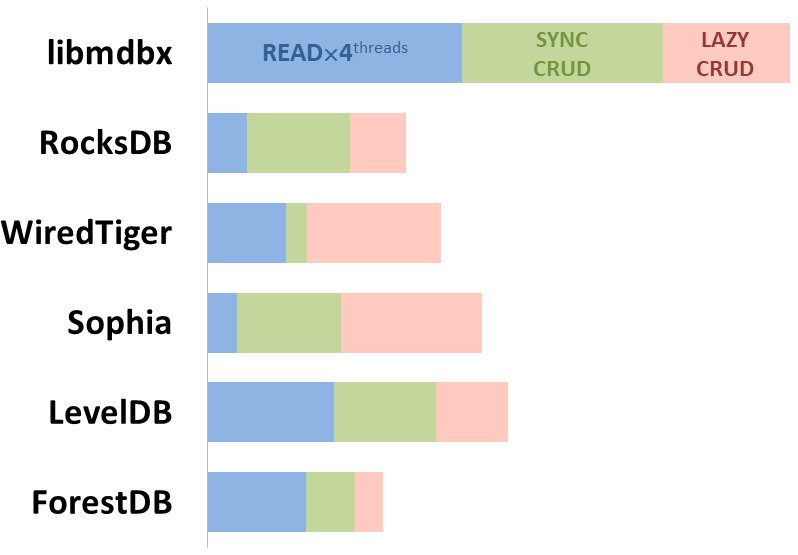 - --------------------------------------------------------------------------------- - -### Read Scalability - -Summary performance with concurrent read/search queries in 1-2-4-8 threads on 4 CPU cores machine. - -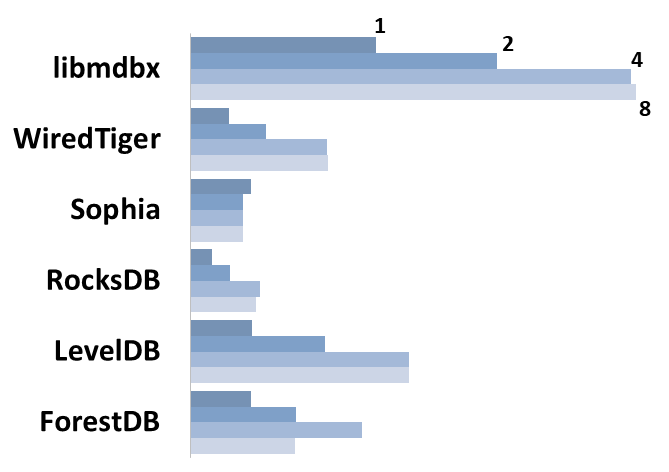 - --------------------------------------------------------------------------------- - -### Sync-write mode - - - Linear scale on left and dark rectangles mean arithmetic mean transactions per second; - - - Logarithmic scale on right is in seconds and yellow intervals mean execution time of transactions. - Each interval shows minimal and maximum execution time, cross marks standard deviation. - -**10,000 transactions in sync-write mode**. In case of a crash all data is consistent and state is right after last successful transaction. [fdatasync](https://linux.die.net/man/2/fdatasync) syscall is used after each write transaction in this mode. - -In the benchmark each transaction contains combined CRUD operations (2 inserts, 1 read, 1 update, 1 delete). -Benchmark starts on empty database and after full run the database contains 10,000 small key-value records. - -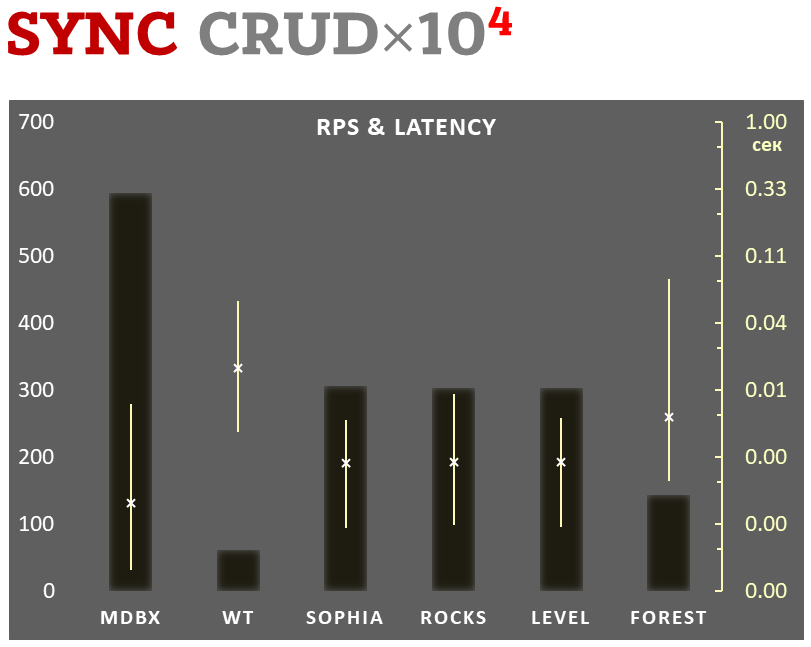 - --------------------------------------------------------------------------------- - -### Lazy-write mode - - - Linear scale on left and dark rectangles mean arithmetic mean of thousands transactions per second; - - - Logarithmic scale on right in seconds and yellow intervals mean execution time of transactions. Each interval shows minimal and maximum execution time, cross marks standard deviation. - -**100,000 transactions in lazy-write mode**. -In case of a crash all data is consistent and state is right after one of last transactions, but transactions after it -will be lost. Other DB engines use [WAL](https://en.wikipedia.org/wiki/Write-ahead_logging) or transaction journal for that, -which in turn depends on order of operations in journaled filesystem. _libmdbx_ doesn't use WAL and hands I/O operations -to filesystem and OS kernel (mmap). - -In the benchmark each transaction contains combined CRUD operations (2 inserts, 1 read, 1 update, 1 delete). -Benchmark starts on empty database and after full run the database contains 100,000 small key-value records. - - -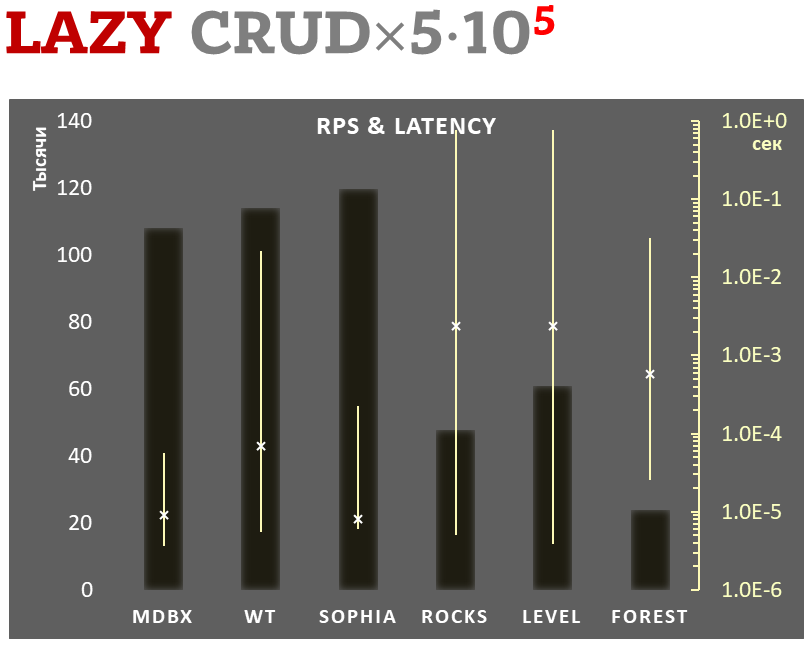 - --------------------------------------------------------------------------------- - -### Async-write mode - - - Linear scale on left and dark rectangles mean arithmetic mean of thousands transactions per second; - - - Logarithmic scale on right in seconds and yellow intervals mean execution time of transactions. Each interval shows minimal and maximum execution time, cross marks standard deviation. - -**1,000,000 transactions in async-write mode**. In case of a crash all data will be consistent and state will be right after one of last transactions, but lost transaction count is much higher than in lazy-write mode. All DB engines in this mode do as little writes as possible on persistent storage. _libmdbx_ uses [msync(MS_ASYNC)](https://linux.die.net/man/2/msync) in this mode. - -In the benchmark each transaction contains combined CRUD operations (2 inserts, 1 read, 1 update, 1 delete). -Benchmark starts on empty database and after full run the database contains 10,000 small key-value records. - -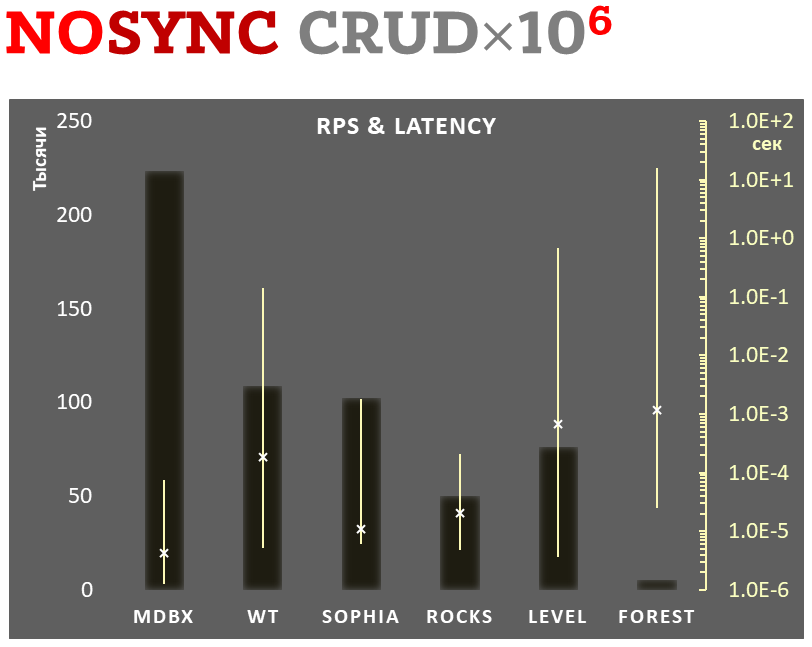 - --------------------------------------------------------------------------------- - -### Cost comparison - -Summary of used resources during lazy-write mode benchmarks: - - - Read and write IOPS; - - - Sum of user CPU time and sys CPU time; - - - Used space on persistent storage after the test and closed DB, but not waiting for the end of all internal - housekeeping operations (LSM compactification, etc). - -_ForestDB_ is excluded because benchmark showed it's resource consumption for each resource (CPU, IOPS) much higher than other engines which prevents to meaningfully compare it with them. - -All benchmark data is gathered by [getrusage()](http://man7.org/linux/man-pages/man2/getrusage.2.html) syscall and by -scanning data directory. - -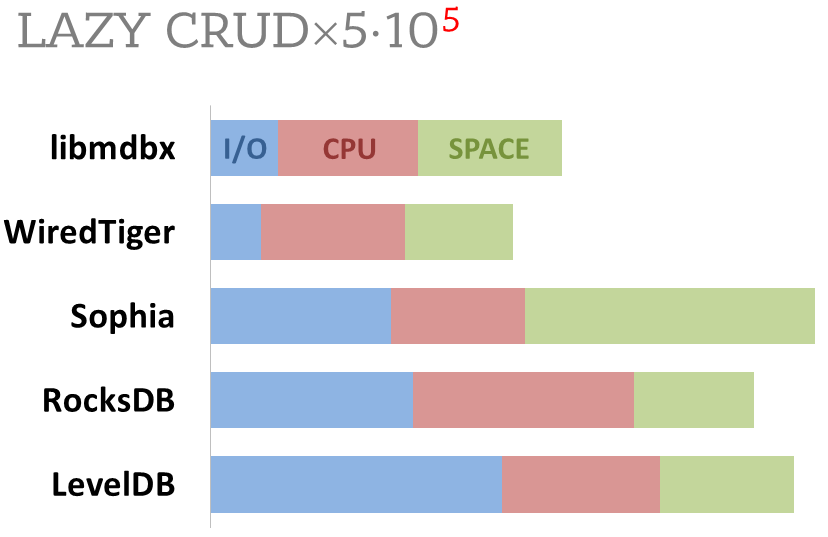 - --------------------------------------------------------------------------------- - -## Gotchas - -1. At one moment there can be only one writer. But this allows to serialize writes and eliminate any possibility - of conflict or logical errors during transaction rollback. - -2. No [WAL](https://en.wikipedia.org/wiki/Write-ahead_logging) means relatively - big [WAF](https://en.wikipedia.org/wiki/Write_amplification) (Write Amplification Factor). - Because of this syncing data to disk might be quite resource intensive and be main performance bottleneck - during intensive write workload. - > As compromise _libmdbx_ allows several modes of lazy and/or periodic syncing, including `MAPASYNC` mode, which modificate - > data in memory and asynchronously syncs data to disk, moment to sync is picked by OS. - > - > Although this should be used with care, synchronous transactions in a DB with transaction journal will require 2 IOPS - > minimum (probably 3-4 in practice) because of filesystem overhead, overhead depends on filesystem, not on record - > count or record size. In _libmdbx_ IOPS count will grow logarithmically depending on record count in DB (height of B+ tree) - > and will require at least 2 IOPS per transaction too. - -3. [CoW](https://en.wikipedia.org/wiki/Copy-on-write) - for [MVCC](https://en.wikipedia.org/wiki/Multiversion_concurrency_control) is done on memory page level with [B+ - trees](https://ru.wikipedia.org/wiki/B-%D0%B4%D0%B5%D1%80%D0%B5%D0%B2%D0%BE). - Therefore altering data requires to copy about Olog(N) memory pages, which uses [memory bandwidth](https://en.wikipedia.org/wiki/Memory_bandwidth) and is main performance bottleneck in `MAPASYNC` mode. - > This is unavoidable, but isn't that bad. Syncing data to disk requires much more similar operations which will - > be done by OS, therefore this is noticeable only if data sync to persistent storage is fully disabled. - > _libmdbx_ allows to safely save data to persistent storage with minimal performance overhead. If there is no need - > to save data to persistent storage then it's much more preferable to use `std::map`. - - -4. LMDB has a problem of long-time readers which degrades performance and bloats DB - > _libmdbx_ addresses that, details below. - -5. _LMDB_ is susceptible to DB corruption in `WRITEMAP+MAPASYNC` mode. - _libmdbx_ in `WRITEMAP+MAPASYNC` guarantees DB integrity and consistency of data. - > Additionally there is an alternative: `UTTERLY_NOSYNC` mode. Details below. - - -#### Long-time read transactions problem - -Garbage collection problem exists in all databases one way or another (e.g. VACUUM in PostgreSQL). -But in _libmdbx_ and LMDB it's even more important because of high performance and deliberate -simplification of internals with emphasis on performance. - -* Altering data during long read operation may exhaust available space on persistent storage. - -* If available space is exhausted then any attempt to update data - results in `MAP_FULL` error until long read operation ends. - -* Main examples of long readers is hot backup - and debugging of client application which actively uses read transactions. - -* In _LMDB_ this results in degraded performance of all operations - of syncing data to persistent storage. - -* _libmdbx_ has a mechanism which aborts such operations and `LIFO RECLAIM` - mode which addresses performance degradation. - -Read operations operate only over snapshot of DB which is consistent on the moment when read transaction started. -This snapshot doesn't change throughout the transaction but this leads to inability to reclaim the pages until -read transaction ends. - -In _LMDB_ this leads to a problem that memory pages, allocated for operations during long read, will be used for operations -and won't be reclaimed until DB process terminates. In _LMDB_ they are used in -[FIFO](https://en.wikipedia.org/wiki/FIFO_(computing_and_electronics)) manner, which causes increased page count -and less chance of cache hit during I/O. In other words: one long-time reader can impact performance of all database -until it'll be reopened. - -_libmdbx_ addresses the problem, details below. Illustrations to this problem can be found in the -[presentation](http://www.slideshare.net/leoyuriev/lmdb). There is also example of performance increase thanks to -[BBWC](https://en.wikipedia.org/wiki/Disk_buffer#Write_acceleration) when `LIFO RECLAIM` enabled in _libmdbx_. - -#### Data safety in async-write mode - -In `WRITEMAP+MAPSYNC` mode dirty pages are written to persistent storage by kernel. This means that in case of application -crash OS kernel will write all dirty data to disk and nothing will be lost. But in case of hardware malfunction or OS kernel -fatal error only some dirty data might be synced to disk, and there is high probability that pages with metadata saved, -will point to non-saved, hence non-existent, data pages. In such situation, DB is completely corrupted and can't be -repaired even if there was full sync before the crash via `mdbx_env_sync(). - -_libmdbx_ addresses this by fully reimplementing write path of data: - -* In `WRITEMAP+MAPSYNC` mode meta-data pages aren't updated in place, instead their shadow copies are used and their updates - are synced after data is flushed to disk. - -* During transaction commit _libmdbx_ marks synchronization points as steady or weak depending on how much synchronization - needed between RAM and persistent storage, e.g. in `WRITEMAP+MAPSYNC` commited transactions are marked as weak, - but during explicit data synchronization - as steady. - -* _libmdbx_ maintains three separate meta-pages instead of two. This allows to commit transaction with steady or -weak synchronization point without losing two previous synchronization points (one of them can be steady, and second - weak). -This allows to order weak and steady synchronization points in any order without losing consistency in case of system crash. - -* During DB open _libmdbx_ rollbacks to the last steady synchronization point, this guarantees database integrity. - -For data safety pages which form database snapshot with steady synchronization point must not be updated until next steady -synchronization point. So last steady synchronization point creates "long-time read" effect. The only difference that in case -of memory exhaustion the problem will be immediately addressed by flushing changes to persistent storage and forming new steady -synchronization point. - -So in async-write mode _libmdbx_ will always use new pages until memory is exhausted or `mdbx_env_sync()` is invoked. Total -disk usage will be almost the same as in sync-write mode. - -Current _libmdbx_ gives a choice of safe async-write mode (default) and `UTTERLY_NOSYNC` mode which may result in full DB -corruption during system crash as with LMDB. - -Next version of _libmdbx_ will create steady synchronization points automatically in async-write mode. - --------------------------------------------------------------------------------- - -Improvements over LMDB -================================================ - -1. `LIFO RECLAIM` mode: - - The newest pages are picked for reuse instead of the oldest. - This allows to minimize reclaim loop and make it execution time independent of total page count. - - This results in OS kernel cache mechanisms working with maximum efficiency. - In case of using disk controllers or storages with - [BBWC](https://en.wikipedia.org/wiki/Disk_buffer#Write_acceleration) this may greatly improve - write performance. - -2. `OOM-KICK` callback. - - `mdbx_env_set_oomfunc()` allows to set a callback, which will be called - in the event of memory exhausting during long-time read transaction. - Callback will be invoked with PID and pthread_id of offending thread as parameters. - Callback can do any of these things to remedy the problem: - - * wait for read transaction to finish normally; - - * kill the offending process (signal 9), if separate process is doing long-time read; - - * abort or restart offending read transaction if it's running in sibling thread; - - * abort current write transaction with returning error code. - -3. Guarantee of DB integrity in `WRITEMAP+MAPSYNC` mode: - > Current _libmdbx_ gives a choice of safe async-write mode (default) - > and `UTTERLY_NOSYNC` mode which may result in full - > DB corruption during system crash as with LMDB. For details see - > [Data safety in async-write mode](#data-safety-in-async-write-mode). - -4. Automatic creation of synchronization points (flush changes to persistent storage) - when changes reach set threshold (threshold can be set by `mdbx_env_set_syncbytes()`). - -5. Ability to get how far current read-only snapshot is from latest version of the DB by `mdbx_txn_straggler()`. - -6. `mdbx_chk` tool for DB checking and `mdbx_env_pgwalk()` for page-walking all pages in DB. - -7. Control over debugging and receiving of debugging messages via `mdbx_setup_debug()`. - -8. Ability to assign up to 3 markers to commiting transaction with `mdbx_canary_put()` and then get them in read transaction - by `mdbx_canary_get()`. - -9. Check if there is a row with data after current cursor position via `mdbx_cursor_eof()`. - -10. Ability to explicitly request update of present record without creating new record. Implemented as `MDBX_CURRENT` flag - for `mdbx_put()`. - -11. Ability to update or delete record and get previous value via `mdbx_replace()` Also can update specific multi-value. - -12. Support for keys and values of zero length, including sorted duplicates. - -13. Fixed `mdbx_cursor_count()`, which returns correct count of duplicated for all table types and any cursor position. - -14. Ability to open DB in exclusive mode with `MDBX_EXCLUSIVE` flag, e.g. for integrity check. - -15. Ability to close DB in "dirty" state (without data flush and creation of steady synchronization point) - via `mdbx_env_close_ex()`. - -16. Ability to get additional info, including number of the oldest snapshot of DB, which is used by one of the readers. - Implemented via `mdbx_env_info()`. - -17. `mdbx_del()` doesn't ignore additional argument (specifier) `data` - for tables without duplicates (without flag `MDBX_DUPSORT`), if `data` is not zero then always uses it to verify - record, which is being deleted. - -18. Ability to open dbi-table with simultaneous setup of comparators for keys and values, via `mdbx_dbi_open_ex()`. - -19. Ability to find out if key or value is in dirty page. This may be useful to make a decision to avoid - excessive CoW before updates. Implemented via `mdbx_is_dirty()`. - -20. Correct update of current record in `MDBX_CURRENT` mode of `mdbx_cursor_put()`, including sorted duplicated. - -21. All cursors in all read and write transactions can be reused by `mdbx_cursor_renew()` and MUST be freed explicitly. - > ## Caution, please pay attention! - > - > This is the only change of API, which changes semantics of cursor management - > and can lead to memory leaks on misuse. This is a needed change as it eliminates ambiguity - > which helps to avoid such errors as: - > - use-after-free; - > - double-free; - > - memory corruption and segfaults. - -22. Additional error code `MDBX_EMULTIVAL`, which is returned by `mdbx_put()` and - `mdbx_replace()` in case is ambiguous update or delete. - -23. Ability to get value by key and duplicates count by `mdbx_get_ex()`. - -24. Functions `mdbx_cursor_on_first() and mdbx_cursor_on_last(), which allows to know if cursor is currently on first or - last position respectively. - -25. If read transaction is aborted via `mdbx_txn_abort()` or `mdbx_txn_reset()` then DBI-handles, which were opened in it, - aren't closed or deleted. This allows to avoid several types of hard-to-debug errors. - -26. Sequence generation via `mdbx_dbi_sequence()`. - -27. Advanced dynamic control over DB size, including ability to choose page size via `mdbx_env_set_geometry()`, - including on Windows. - -28. Three meta-pages instead of two, this allows to guarantee consistently update weak sync-points without risking to - corrupt last steady sync-point. - -29. Automatic reclaim of freed pages to specific reserved space at the end of database file. This lowers amount of pages, - loaded to memory, used in update/flush loop. In fact _libmdbx_ constantly performs compactification of data, - but doesn't use additional resources for that. Space reclaim of DB and setup of database geometry parameters also decreases - size of the database on disk, including on Windows. - --------------------------------------------------------------------------------- - -``` -$ objdump -f -h -j .text libmdbx.so - -libmdbx.so: file format elf64-x86-64 -architecture: i386:x86-64, flags 0x00000150: -HAS_SYMS, DYNAMIC, D_PAGED -start address 0x000030e0 - -Sections: -Idx Name Size VMA LMA File off Algn - 11 .text 00014d84 00000000000030e0 00000000000030e0 000030e0 2**4 - CONTENTS, ALLOC, LOAD, READONLY, CODE - -``` - -``` -$ gcc -v -Using built-in specs. -COLLECT_GCC=gcc -COLLECT_LTO_WRAPPER=/usr/lib/gcc/x86_64-linux-gnu/7/lto-wrapper -OFFLOAD_TARGET_NAMES=nvptx-none -OFFLOAD_TARGET_DEFAULT=1 -Target: x86_64-linux-gnu -Configured with: ../src/configure -v --with-pkgversion='Ubuntu 7.2.0-8ubuntu3' --with-bugurl=file:///usr/share/doc/gcc-7/README.Bugs --enable-languages=c,ada,c++,go,brig,d,fortran,objc,obj-c++ --prefix=/usr --with-gcc-major-version-only --program-suffix=-7 --program-prefix=x86_64-linux-gnu- --enable-shared --enable-linker-build-id --libexecdir=/usr/lib --without-included-gettext --enable-threads=posix --libdir=/usr/lib --enable-nls --with-sysroot=/ --enable-clocale=gnu --enable-libstdcxx-debug --enable-libstdcxx-time=yes --with-default-libstdcxx-abi=new --enable-gnu-unique-object --disable-vtable-verify --enable-libmpx --enable-plugin --enable-default-pie --with-system-zlib --with-target-system-zlib --enable-objc-gc=auto --enable-multiarch --disable-werror --with-arch-32=i686 --with-abi=m64 --with-multilib-list=m32,m64,mx32 --enable-multilib --with-tune=generic --enable-offload-targets=nvptx-none --without-cuda-driver --enable-checking=release --build=x86_64-linux-gnu --host=x86_64-linux-gnu --target=x86_64-linux-gnu -Thread model: posix -gcc version 7.2.0 (Ubuntu 7.2.0-8ubuntu3) -``` |